Introduction
Prepaid gift cards are everywhere—birthdays, holidays, online purchases, even rewards. They’re simple, flexible, and widely accepted. But that same simplicity makes them an easy target for fraud.
If you’re using gift cards regularly or even just holding onto a few, knowing how to protect them isn’t optional anymore—it’s basic hygiene.
This guide walks through how gift card scams actually work, where people slip up, and what habits quietly keep your balance safe.
Why Gift Cards Are a Target
Gift cards are attractive to scammers for one reason: they behave like cash but are harder to trace.
Once someone has the card number and PIN, the money is essentially gone. There’s no chargeback system like credit cards. No identity verification step. No friction.
That means attackers don’t need sophisticated hacks. Most of the time, they rely on:
- Accessing exposed card details
- Social engineering (convincing people to send codes)
- Exploiting weak purchase or storage habits
It’s less about breaking systems—and more about catching people off guard.
The Most Common Gift Card Scams
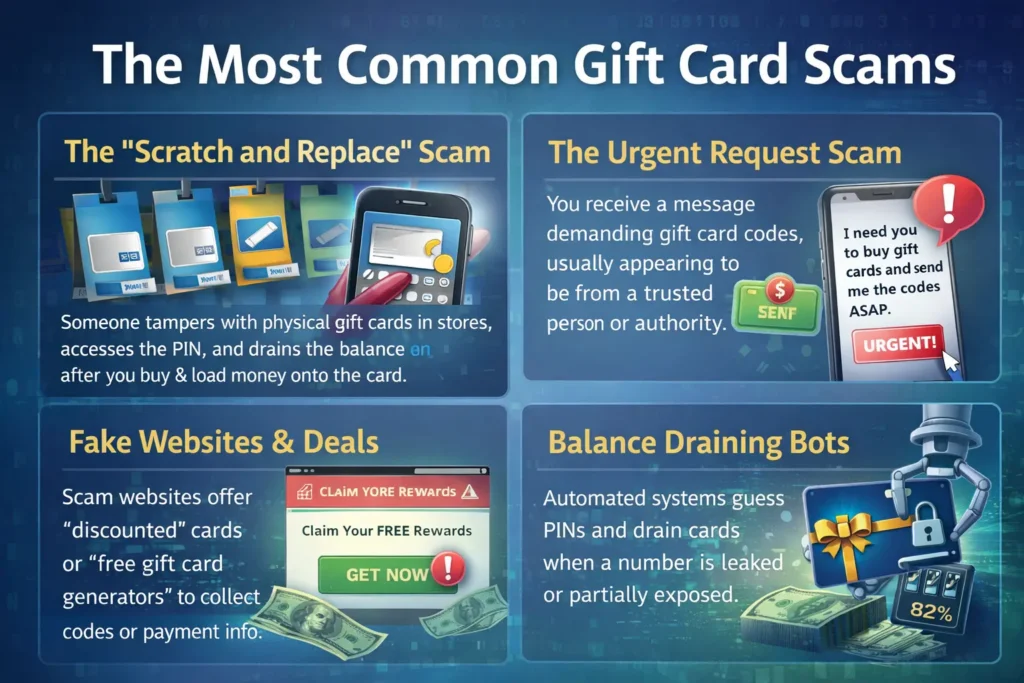
Understanding patterns helps more than memorizing rules. These are the ones showing up most often:
1. The “Scratch and Replace” Scam
Someone tampers with physical cards in stores:
- They scratch off the PIN
- Record the numbers
- Cover it back up
You buy the card, load money, and later find it drained.
2. The Urgent Request Scam
You get a message like:
“I need you to buy gift cards and send me the codes ASAP.”
It might look like your boss, a client, or even a family member. The pressure is the trick.
3. Fake Websites & Deals
Sites offering:
- “Discounted gift cards”
- “Free gift card generators”
- “Claim your reward”
Most of these exist to collect your data—or your money.
4. Balance Draining Bots
If a card number is exposed (even partially), automated systems can:
- Guess PIN combinations
- Monitor balances
- Drain funds the moment they’re loaded
Where People Usually Slip
It’s rarely one big mistake. It’s small things stacking up:
- Buying from unfamiliar third-party sellers
- Leaving cards unused for months
- Sharing codes over email or chat
- Not checking packaging integrity
- Trusting “too good to be true” offers
None of these feel risky in isolation. Together, they create openings.
How to Secure Your Gift Cards (Practical Habits)
You don’t need paranoia. Just a few steady habits.
1. Buy from Trusted Sources
Stick to:
- Official brand websites
- Recognized retailers
- Verified platforms
Avoid random marketplaces unless you fully trust the seller.
2. Inspect Before You Buy
If you’re buying in-store:
- Check the packaging
- Look for tampering around the PIN area
- Avoid cards that look resealed or damaged
If something feels off, pick another card.
3. Use or Redeem Quickly
The longer a card sits unused, the higher the risk.
Best approach:
- Redeem immediately into your account (Amazon, Apple, etc.)
- Or spend it soon after purchase
4. Never Share Codes Publicly
No legitimate company or employer will ask for:
- Gift card numbers
- PIN codes
If someone does, that’s the scam.
5. Keep Proof of Purchase
Receipts matter more than people think.
If something goes wrong:
- It’s your only leverage with support
- It helps track activation and usage
6. Monitor Balances Regularly
Especially for high-value cards:
- Check balances every few days
- Watch for unexpected changes
Catching issues early gives you a small window to act.
Digital vs Physical Cards: Which Is Safer?
There’s no perfect option—just different trade-offs.
Digital Cards
- Safer from physical tampering
- Risk comes from phishing or email access
Physical Cards
- Tangible and easy to gift
- Risk comes from store tampering or exposure
If security is your priority, digital cards usually edge out—as long as your email and accounts are secure.
What to Do If Your Gift Card Is Compromised
Timing matters here. Once funds are used, recovery is difficult—but not always impossible.
Take these steps immediately:
- Contact the card issuer
Provide card number, receipt, and any transaction details - Freeze or report the card
Some providers can lock remaining balance - Document everything
Screenshots, emails, timestamps - Report the incident
Helps build patterns and sometimes supports recovery
Don’t wait to “see what happens.” By then, it usually already has.
A Simple Mental Model
You don’t need to memorize everything. Just hold onto this:
Treat gift cards like cash with a password.
- If someone sees the number → risk
- If someone gets the PIN → money gone
- If you delay using it → exposure increases
That alone filters out most bad decisions.
Final Thought
Most people don’t think about gift card security until something goes wrong. And by then, it’s already quiet and irreversible.
The safer approach is simpler than it sounds:
- Buy clean
- Store carefully
- Use quickly
- Share nothing
No drama. Just consistency.